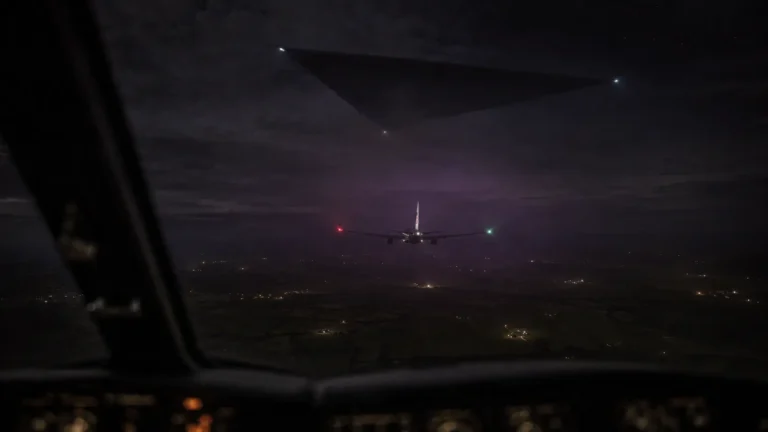
On the evening of 4 January 2004, two commercial aircraft were on approach to Dublin Airport when, according to the accounts that would later emerge, they encountered something in Irish airspace that neither crew could identify, that appeared on air traffic control radar, and that left one of the aircraft with physical damage that grounded it on arrival. No official investigation report has ever been published. No statement was ever issued. The incident is known today primarily through the testimony of those who were there and the determined research of one Irish investigator who has spent years trying to establish what the records actually say.
The First Encounter: 20:30, Aer Lingus EI-BXD
The aircraft involved in the first encounter was an Aer Lingus Boeing 737-400 series, registration EI-BXD, carrying 135 passengers and crew on approach to Runway 10 at Dublin Airport. At 8.30 in the evening, the aircraft was fifteen nautical miles from the Ashbourne VOR navigation beacon, at a chart position of 53 degrees 31 minutes west, flying inbound on a QDM of 190 degrees. Altitude was 3,000 feet above mean sea level. Airspeed was 250 knots, standard for below 10,000 feet.
Six miles behind the 737, also on approach to Runway 10, was a British Midlands Airbus 330.
As the 737 crossed the Slane area of County Meath, the crew of the Airbus 330 behind it observed something taking off from a field below, accompanied by intense strobe-like flashes of light. The Airbus crew reported being able to make out a triangular shape to the object. It climbed rapidly and began to circle the Aer Lingus 737 ahead of them.
According to the account that was later published, the 737 crew experienced a power drain on the aircraft as the object circled them. The Airbus crew, watching from six miles back, observed what they described as a purple-coloured glow surrounding the 737. As the triangular object moved to a position directly ahead of the 737 at the same altitude, the 737 captain requested a vector from air traffic control to avoid a collision. ATC complied, issuing an eight-degree heading change, a significant and disruptive instruction on a busy approach sequence. Crucially, according to the same account, ATC had the object on radar. A radar return on an unidentified object at 3,000 feet on a controlled approach path is not something controllers can ignore.
The 737 landed without further incident from the crew’s perspective, but on arrival the aircraft was directed to Stand 132. When engineers examined the aircraft, they found the speed brakes could not be raised more than a quarter of their full travel. Further inspection revealed physical damage to the wing skin described as similar to denting by a hammer, along with hydraulic damage to the speed brake system. The account states that the crew were taken to the lounge, told to await further instructions, and subsequently sent home for two days.
The Second Encounter: 22:30, an Airbus 330-200
Two hours later, at 10.30 the same evening, a second aircraft was on approach to Dublin from the east. This was an Airbus 330-200 series carrying 213 people. As it crossed the Slane area, the crew observed a flashing strobe light in the same general location as the earlier incident.
The object in this case manoeuvred around the aircraft. According to the account, the wake turbulence generated by the object was severe enough to shake the Airbus and trigger the aircraft’s wind shear warning system. This device detects sudden changes in wind speed or direction and automatically pitches the aircraft nose down to prevent a stall. Its activation is not a trivial event. Other aircraft in the area were following the radio transmissions between the Airbus crew and ATC throughout the encounter.
Two minutes before the Airbus landed, the object departed to the south-east at high speed.
In conversations among pilots in the aftermath, the consensus was that the area north of the Ashbourne VOR, covering the Navan and Slane region of County Meath, had become a location where unexplained aerial activity had been noted repeatedly over the previous three or four years.
What the Records Show, and What They Don’t
This account deserves careful handling. The detailed version of events above, including the aircraft registration, the specific navigation data, the physical damage, and the crew’s treatment afterwards, comes primarily from a report attributed to an anonymous Aer Lingus pilot, published by Old Moore’s Almanac and discussed at length by Irish UFO researcher Chris Gaffney. It has not been confirmed by an official Air Accident Investigation Unit report, an Irish Aviation Authority statement, or any Aer Lingus disclosure.
That absence of official documentation is itself significant, but not in the way it might first appear. The specific technical details in the account, the aircraft registration, the VOR bearings, the altitude and speed figures, the runway designation, are consistent with how a pilot would report an incident and are not the kind of details a fabricated story typically includes. Aviation professionals speak in these terms; storytellers generally don’t.
What can be confirmed is that Aer Lingus did operate Boeing 737-400 series aircraft on domestic and short-haul routes in early 2004, and that registration EI-BXD was a real aircraft in the fleet. The airline withdrew its last Boeing 737s from service in October 2005. The Ashbourne VOR is a real navigation beacon used on approach to Dublin Runway 10. The procedural details in the account are accurate.
What cannot currently be confirmed through publicly available official sources is the UFO encounter itself, the physical damage to the aircraft, or the subsequent handling of the crew.
Chris Gaffney and the FOI Pursuit
The 2004 incident is one of the cases that Irish UFO researcher Chris Gaffney has investigated most persistently. Gaffney, a Dublin-based private pilot who began researching UAP in the early 1970s, has spent years submitting Freedom of Information requests to Irish and European bodies seeking documentation of aerial incidents involving unidentified objects.
In November 2021, Gaffney submitted an FOI to Vice Admiral Mark Mallet, then Chief of the Irish Defence Forces, requesting access to all UAP records held by Oglaigh na hEireann. The request was granted in part and refused in part under Section 33(1)(A) of the Freedom of Information Act 2014, the provision covering information whose release could be detrimental to the security of the State. The refusal was challenged with the Office of the Information Commissioner.
Gaffney has also submitted FOI requests to multiple European institutions, including the Council of the European Union, the European Parliament, the European Aviation Safety Agency, and the European Union Satellite Centre. The pattern of responses, partial releases, referrals, and formal refusals, has itself become a body of evidence about how European governments handle UAP documentation.
His work on the 2004 incident specifically has been discussed in detail in a 2024 interview on the UFO Talker podcast, in which Gaffney also references the Shannon ATC audio from the 2018 incident involving British Airways, Virgin, and Norwegian airline crews. Gaffney serves as the Deputy National Representative for the International Coalition for Extraterrestrial Research (ICER) and is involved in UKPRU, the United Kingdom Pilots Reporting UAP network.
The Broader Pattern Over Meath
The 4 January 2004 incidents did not occur in isolation. Reports of unexplained aerial activity in the airspace north of Dublin, particularly over the Meath and Louth corridor, had been circulating among aviation professionals for several years before the date in question. The area sits beneath the standard approach paths to Dublin Airport from the north and northeast, making it a location with a high density of commercial air traffic and therefore a higher probability of aerial encounters being observed by trained, credible witnesses.
In 2003, pilots on approach to Dublin had separately reported a strange moving red disc over Fingal and the Irish Sea, with neither aircrew nor ATC at Dublin Airport able to identify it. The 2004 incidents, if accurate, represent an escalation from a visual anomaly to a physical interaction with a commercial aircraft.
The involvement of two separate aircraft on the same evening, the claimed radar return, the physical evidence of damage on landing, and the reported presence of multiple witnesses across both incidents are the features that distinguish this case from the majority of Irish UFO reports. Most sightings are single-witness visual observations with no corroborating data. This account, if it holds up to investigation, is something considerably more serious.
Why No Official Investigation?
Under Irish and international aviation law, any incident involving physical damage to a commercial aircraft during flight is subject to mandatory investigation by the Air Accident Investigation Unit. If the damage described in this account occurred in the way it is described, an AAIU investigation would have been obligatory, and its report would eventually be published in the public domain.
No such report is publicly available for EI-BXD on 4 January 2004.
This leaves several possibilities. The damage may have been attributed to a different cause, one that triggered a maintenance report rather than a safety investigation. The incident may have been handled at a level above normal AAIU jurisdiction. The account, despite its technical specificity, may contain inaccuracies that prevent a direct match to official records. Or the relevant documentation may exist but remain classified, which would be consistent with the partial refusals Chris Gaffney has encountered in his FOI work.
None of these explanations is comfortable. All of them are plausible.
What is certain is that on the night of 4 January 2004, something was reported in the airspace over County Meath by professional aviation crews. Air traffic control appears to have been aware of it. And whatever it was, it was close enough to a commercial aircraft carrying 135 people that a collision avoidance vector was issued.
That much, at a minimum, deserves an answer.
If you are a pilot, ATC professional, or crew member with knowledge of incidents in Irish airspace, we would like to hear from you. All contacts are treated in confidence. Use the Report a Sighting form on this site.