Long before the term “flying saucer” existed, long before Roswell, long before government hearings and declassified footage and UAP task forces, sixteen people in County Tipperary sat down and put their names to one of the strangest accounts in Irish history. The date was 2 March 1679. What they described, by any modern classification, was an unidentified flying object. What makes this story remarkable is not just what they saw, but the fact that they documented it so carefully, and that the document survives.
The Place and the Date
The location was Poins-town, recorded variously in contemporary sources as Poinstowne or Poynstowne, in the Slieveardagh hills of south Tipperary. Today, the area is known as a quiet agricultural landscape of low hills near the Kilkenny border. In 1679, it was a rural settlement in a country still absorbing the upheaval of Cromwell’s campaigns and the instability of the Restoration period. Life for most people was local, largely oral, and governed by what could be directly observed.
The date, written as “March the second, 1678/9”, reflects the Julian calendar then in use across Ireland and Britain, under which the new year began on 25 March rather than 1 January. In modern reckoning, this is 2 March 1679. It was, according to every account given by those present, a clear and completely calm evening. No cloud. No mist. No wind.
What Sixteen Witnesses Said They Saw
The accounts that emerged from that evening were gathered, verified by oath, first published in Dublin, and then reprinted in London the same year under the title: A True Account of Divers most Strange and Prodigious Apparitions seen in the air at Poins-town in the County of Tipperary in Ireland. Attested by sixteen persons that were eye-witnesses. Published at Dublin, and thence communicated hither.
The named witnesses include Mr C Hewetson, Mr R Foster, a Mr Grace, a Lieutenant Dwine, and a Mr Larkin, along with eleven others whose names are recorded in the document itself. These were not anonymous rumours or single-witness claims. Sixteen people put their names to a formal, sworn account and submitted it for publication.
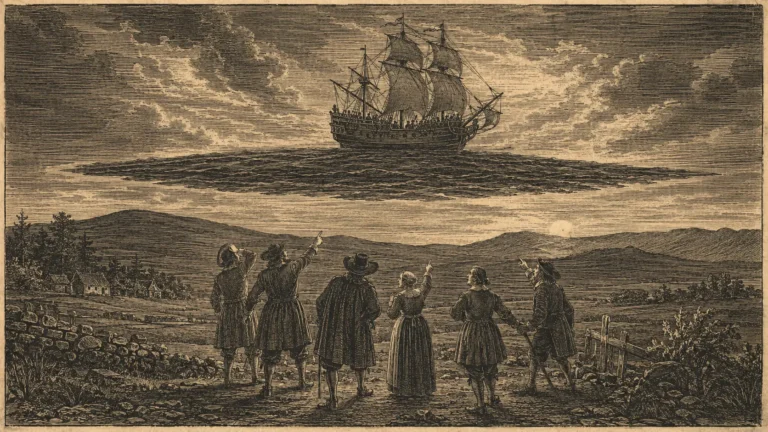
What they described began with a ship. At a great distance in the air, something appeared that looked, to everyone watching, like a sailing vessel approaching them. It came close enough, they reported, that they could make out the masts, the sails, the rigging, and the figures of men aboard. The ship then appeared to change course, turning so that it moved stern-first in a northward direction, travelling across what the witnesses described as a dark, smooth sea that had not been visible a moment before, stretching from southwest to northwest across the sky.
The ship sailed in this manner for several minutes before sinking gradually below the horizon of this impossible sea, stern first. As it descended, the witnesses reported seeing the men on board running up the rigging toward the bow, as though trying to save themselves from drowning.
That alone would be extraordinary. But the sighting did not end there.
A Procession of Apparitions
After the ship disappeared, the witnesses described a series of further apparitions in the same section of sky. Two ships appeared, apparently engaged in combat with one another. Then a chariot. Then a serpent. Then a bull. Then a dog.
All of this, they insisted, occurred on that same clear, calm, windless evening.
The variety of what they claimed to see raises an obvious question. Either the event was a genuine and extraordinary atmospheric phenomenon that the witnesses interpreted through the visual language available to them, or a shared psychological experience of some kind occurred, or the document is a fabrication. Each of these possibilities has been discussed by historians and researchers since the account was first published.
The fabrication theory is the least satisfying. Sixteen named witnesses, a formal publication in Dublin, a London reprint, and a document that has survived in institutional collections for three and a half centuries do not have the characteristics of a straightforward hoax. More plausible is the atmospheric explanation.
What Might Have Happened
The phenomenon known as Fata Morgana is a form of atmospheric mirage caused by temperature inversions in the air. Under the right conditions, it can produce vivid images of ships, coastlines, cliffs, and other structures in the sky, sometimes in considerable detail, sometimes for extended periods. Such mirages have been documented over both sea and land. They are particularly associated with calm conditions and specific temperature gradients, which matches precisely what the Poins-town witnesses described: a clear, still evening, no cloud, no mist, no wind.
A Fata Morgana can project the inverted image of a real ship at sea onto the sky above a distant inland location, distorting and elongating it. To observers who had never encountered such a phenomenon, and who had no framework within which to interpret it, a sailing ship apparently crossing the heavens would be exactly what they would see. The appearance of the “dark smooth sea” that the witnesses described materialising in the sky is also consistent with this type of mirage.
The subsequent apparitions, the two fighting ships, the chariot, the serpent, are harder to account for by the same mechanism, though atmospheric mirages are known to shift and distort rapidly, and group witnesses under stress can interpret ambiguous visual stimuli differently. It is also worth noting that 1679 was a year of considerable social anxiety in both Ireland and Britain, with political and religious tensions running high. How people interpret what they see is rarely separable from what they expect or fear to see.
None of this explains the account definitively. It is a possible explanation, not a proven one.
Ireland Was Not Alone That Year
One detail that adds genuine historical weight to the Tipperary account is that it was not the only report of its kind from 1679. The Huntington Library in California, which holds a copy of the Tipperary document, also holds a contemporary English pamphlet entitled Strange news from Barkshire, of an apparition of several ships and men in the air, which seemed to the beholders to be fighting. This account describes witnesses near Abingdon, Berkshire, in August of the same year, seeing what appeared to be ships engaged in aerial combat.
Two separate groups of witnesses, in two different countries, describing the same basic phenomenon within months of each other in 1679, is a coincidence that has attracted the attention of researchers ever since. Whether this points to an unusual atmospheric event occurring across a wide area that year, or to something else entirely, is not established.
The Document and Its Survival
The original pamphlet ran to eight pages and was printed in London by “L.C.” in 1679 following its initial Dublin publication. It is an extremely rare surviving copy. The Huntington Library in San Marino, California holds one. Until recently, only one copy was recorded in Ireland, held by De Burca Rare Books of Blackrock, Co. Dublin, which offered it for sale in 2021 at €1,750.
The document predates the modern UFO era by nearly three centuries. Kenneth Arnold’s famous 1947 sighting over Mount Rainier in Washington State is generally cited as the beginning of the contemporary flying saucer phenomenon. The Irish Defence Forces began their own dossier of unexplained aerial phenomena that same year. The Tipperary witnesses signed their names to their account 268 years before any of that.
They had no concept of aircraft, no framework of science fiction, no cultural expectation of extraterrestrial visitors. They described, in careful and specific language, something they witnessed in the sky above a quiet hillside in south Tipperary on a calm March evening, and then they put their names to it.
Why This Account Still Matters
The Poins-town document sits at an unusual intersection of history, folklore, atmospheric science, and the broader question of how people in any era make sense of things they cannot explain. It is not a story that can be dismissed as a product of the UFO obsession of the 1950s or the social media age. It predates all of that by centuries, which is precisely why it is worth taking seriously.
Whether the sixteen witnesses of Slieveardagh saw a Fata Morgana, some other atmospheric event, or something genuinely unclassifiable, they saw something. They agreed on what they saw. They went to the trouble of recording and publishing their account at a time when doing so required significant effort and carried social risk. And the document they produced has outlasted almost everything else from that period of Tipperary life.
Ireland’s oldest UFO account is also, in its way, one of Ireland’s most carefully documented ones.
Have you had a sighting in Co. Tipperary or elsewhere in Ireland? Use the Report a Sighting form on this site.