In the summer of 1996, something happened in the Curlew Mountains outside Boyle, Co. Roscommon, that divided opinion and has never been officially explained. Reports spread quickly through the locality: bright lights hurtling from the sky, a security cordon thrown around the area, and Gardai being told in blunt terms to walk away from the scene. It was an incident that would come to be known as Ireland’s Roswell.
A Crash in the Curlew Mountains
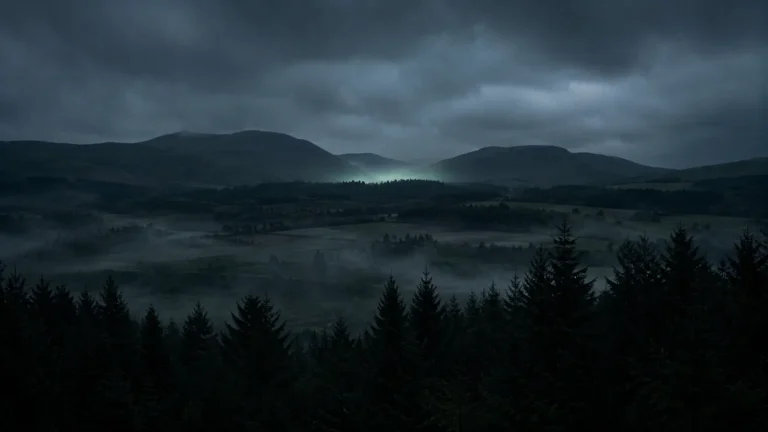
In May 1996, residents of the Boyle area reported witnessing intense bright lights moving at speed across the night sky before appearing to come down in the Curlew Mountains on the outskirts of the town. Eyewitness accounts described the lights hurtling into trees, with debris reported across a wide area of the crash site.
What followed, according to multiple local accounts, was swift and striking. Members of the Irish Defence Forces and security personnel are said to have mobilised rapidly, arriving at the scene and cordoning off the surrounding area. Shortly afterwards, a convoy of large cars arrived carrying unnamed politicians and, according to several accounts, representatives of the US Embassy in Dublin. A number of US military Jeeps were also reportedly observed in the area. Given Ireland’s policy of military neutrality, that detail alone was remarkable.
What made the story take on a life of its own was what was said to have happened next. An anonymous Garda based in Boyle reportedly told colleagues, and eventually local press, that local police had been told in no uncertain terms to stay out of it. Government officials at the scene allegedly instructed the Gardai to keep their distance, leaving the area entirely in the hands of unnamed state and foreign personnel.
No official statement was ever issued. No explanation was ever given.
Rory Thornton and the Cover-Up Claims
The incident first reached a wider national audience when UFO researcher Rory Thornton, who at the time ran a practice in Newcastle, Co. Galway, went public with his investigation. Thornton drew an explicit comparison to the 1947 Roswell Incident in New Mexico, suggesting that the Irish government had engaged in a similar pattern of suppression and misdirection.
His claims were specific. According to Thornton, the object had come down in difficulty, struck trees, and come to rest in a local lake. He maintained that whatever had been recovered from the site was not of conventional origin, and that the involvement of US Embassy personnel pointed to a level of official sensitivity that only attaches itself to incidents of genuine significance.
Sceptics pushed back, and with some justification. The political backdrop of 1996 Ireland was itself extraordinary. The country was in the midst of a series of tribunals exposing serious governmental corruption, and the notion that some form of cover-up was plausible was, if anything, easier to believe than usual. One commentator of the time drily noted that the arrival of unnamed politicians at a crash site was hardly the most surprising thing to emerge from 1990s Ireland.
Alternative explanations were offered. One serious possibility raised by investigators was that a drop tank from a US military aircraft had come loose over Irish territory. Such an incident would have caused considerable political embarrassment given Irish neutrality, and would have warranted exactly the kind of rapid, quiet response that local witnesses described. A precedent existed: some years earlier, an unexplained object had buried itself in the Wicklow Mountains, British officials appeared, removed it, and the matter was never spoken of again.
Whether the Boyle incident involved a military drone, a piece of errant hardware, or something stranger still, people in the area remained adamant that something significant had come down that night, and that the official response had been far from routine.
Betty Meyler: Ireland’s Most Famous UFO Enthusiast
The Boyle incident might have faded from memory entirely had it not profoundly affected one woman who would go on to become the most recognisable figure in Irish UFO research.
Betty Meyler was a remarkable character who had already lived several lives by the time she settled in Boyle. Born in India to a newspaper editor father, she had eloped to Lagos at seventeen, run a hotel in Guernsey with a former RAF officer, obtained a pilot’s licence, trekked the Himalayas, and visited Machu Picchu, all before turning her considerable energy to the question of unidentified aerial phenomena.
It was newspaper reports of the Curlew Mountains crash that ignited her interest. In 1996, inspired by the local accounts surrounding the incident, Meyler decided that what was needed was a society where people could discuss such matters without being laughed out of the room. She hired a meeting room, placed an announcement, and waited. One person arrived. Unperturbed, Meyler solemnly proposed herself for the positions of president, secretary, and treasurer, seconded herself, and declared the UFO Society of Ireland officially in existence.
From that singular beginning, she built something remarkable. By the time she organised her first international UFO conference, she had appeared in multiple documentaries, been interviewed by almost every radio station in the country, and (a point of particular pride) shared the cover of Women’s Way magazine with Robbie Williams.
Betty was also convinced that the Boyle area held a special significance beyond the 1996 crash. She believed she had identified a UFO portal just off Church Island on Lough Key, and was regularly to be seen on the lake in her late seventies, swinging a dowsing pendulum as bemused local helpers scanned the horizon. She took any scepticism in very good humour. When asked if she was making sandwiches for the little green men, she replied that she was not, but that she was open to the enquiry.
Betty Meyler died in October 2010 at the age of seventy-nine, having spent her final years still actively investigating and still wholly unconvinced that the skies above Co. Roscommon were anything less than extraordinary.
Lough Key and the Broader Pattern of Sightings
The 1996 crash was not the only incident to put Boyle on the UFO map. A year later, in the summer of 1997, two friends from Co. Tyrone (Barry Brown and Mark Monaghan) were on a camping trip in the woodlands beside Lough Key when they encountered something they have never been able to explain.
Walking through the forest, the pair observed a craft moving silently overhead. Monaghan later described it as cigar or sausage-shaped, roughly the size of a bus, with four large lights along its side and a clearly metallic appearance. The object passed approximately 500 metres above them before hovering silently over the waters of Lough Key. The two men did not follow it.
“It definitely scared us. There was a real sense that we were watching them and they were watching us right back.”
Mark Monaghan, witness, summer 1997
The sighting was later featured in an RTE documentary broadcast in 2001, alongside footage of a similar unidentified cylindrical object near Lough Key captured by Dr Eamonn Ansbro, a professional astronomer based at Kingsland Observatory in Boyle. Dr Ansbro has spent decades systematically monitoring the skies above Roscommon and has recorded in excess of forty UFO sightings in the county over more than twenty years of observation. His work is methodical and scientific, and he has collaborated with colleagues internationally in attempting to establish whether the objects he tracks follow predictable orbital patterns.
Linda Dungan Young, Ireland’s national director for the Mutual UFO Network (MUFON), has spoken about the difficulty of investigating sightings that are decades old. “We would be looking at what else was in the area at the time. We do due diligence by excluding everything first. We might say ‘This is a UFO’ but we wouldn’t then say ‘This is aliens’. Just that it’s unidentified.”
It is a distinction worth holding on to. The question of what came down in the Curlew Mountains in May 1996 remains genuinely open. The security response, the reported presence of US diplomatic and military personnel, and the instruction to local Gardai to withdraw all suggest that what occurred was considered sensitive at the highest level.
The Name That Stuck
Roswell, New Mexico, earned its place in UFO history from a single incident in 1947 that the US military first acknowledged and then rapidly explained away as a weather balloon. Decades of investigation, declassified documents, and persistent witness testimony have kept the case alive and unresolved.
Boyle’s claim to a similar designation rests on comparable foundations: a significant aerial event, a swift and unexplained official response, a community of witnesses who remain certain of what they saw, and a silence from government that has never been adequately accounted for.
Unlike Roswell, Ireland’s version has no dedicated museum, no annual festival, and no highway named in its honour. What it does have is a growing body of documented sightings around Lough Key and the Curlew Mountains, an astronomer who has spent his career recording unexplained phenomena in Roscommon skies, and the enduring memory of a woman who founded an entire organisation on the basis of what she believed happened there.
Whatever came down outside Boyle in May 1996, it left a mark on the landscape, on the community, and on Ireland’s quiet but persistent relationship with the unexplained.
Have you had a sighting in or around Boyle or the Curlew Mountains area? We would like to hear from you. Use the Report a Sighting form on this site.